Showing posts with label Day Trip. Show all posts

Friday, April 5, 2019

Kamay ni Hesus: Lucban's Iconic Pilgrimage Site

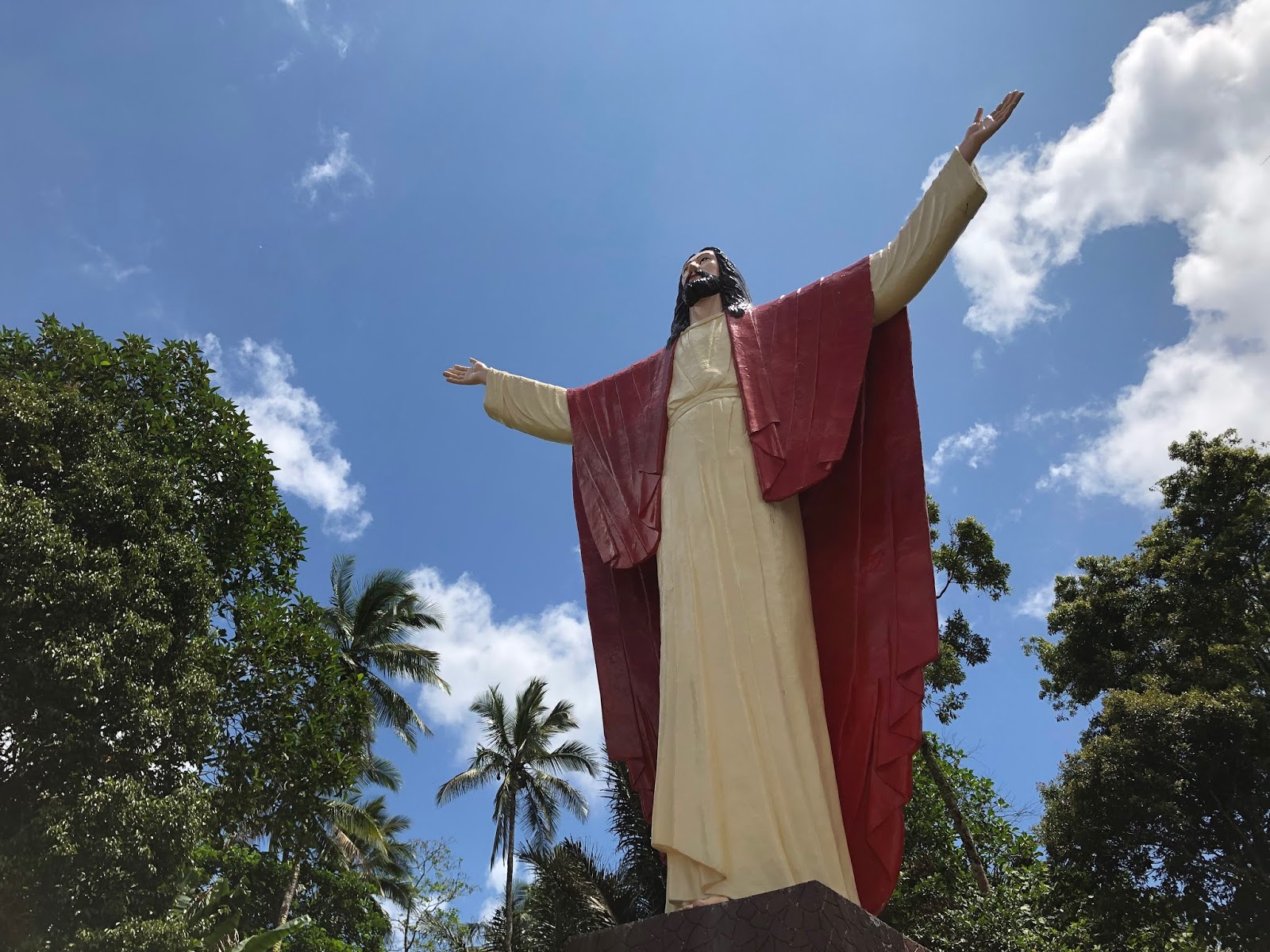
For many Filipino Christians, a pilgrimage to the Kamay ni Hesus Shrine is an experience that enriches their relationship with God. It is therefore not a surprise that in 2018 more than 2 million devotees visited and made it the Philippines' most popular Holy Week pilgrimage site. While in Lucban, we couldn't let the chance to visit this sought-after sanctuary slip by. So a day after we checked out Villa Elma, we set out to Barangay Tinamnan to see the shrine. 
The iconic 50-foot statue of the Risen Christ in Kamay ni Hesus
From Lucban town proper, we drove for just under 15 minutes to reach the gates of Kamay ni Hesus. We came inside and was surprised to find out the entrance to the site is free of charge. However, if you are bringing your car just like us, prepare PHP30 for the parking fees.

Thursday, March 28, 2019

Villa Elma: A Beautiful Pilgrimage Site

Upon arrival in Lucban, we immediately asked around to get insight on places to visit. One suggestion was to visit Villa Elma, said to be an alternative pilgrimage site to the popular Kamay ni Hesus. So we set out, excited to be heading into the foothills of Mount Banahaw into what we hoped would be a quieter and less crowded place.
Villa Elma at the foothills of Mount Banahaw
The beautiful Villa Elma at the foothills of Mount Banahaw
Leaving the town proper behind, we drove for just under 15 minutes to reach the gates of Villa Elma. We came inside and settled the entrance fees of PHP100 per person. We were told we can also dip and swim in the cold mountain stream for another PHP100 but we opted out.
Villa Elma Gates
The conspicuous sign outside the resort

Tuesday, March 26, 2019

Lucban: A Travel Guide for First-Timers

With just a few days left before the Holy week, everyone is already busy preparing to make the most out of the long holiday break. However, if reading this just reminds you that you still haven't figured out where to spend the Holy Week, there is no need to worry. The Two Juanderers recommend visiting the town of Lucban in Quezon. Aside from being close and accessible to Manila, Lucban offers many notable spots to relax and to embrace the days of Lent. 
Kamay ni Hesus Lucban
Lucban is a popular pilgrimage destination south of Luzon
Find out more about seeing Lucban with Two Juanderer's beginner's guide for travelers to this beautiful pilgrimage destination.

The Town
Lucban is an inland town at the northwestern border of Quezon province. It is nestled at the foot of the majestic and mysterious Mount Banahaw. It stands at an elevation of 1,500 feet above sea level. The town enjoys gentle, cool mountain breeze and experiences pleasant temperatures throughout the year. As such it is sometimes dubbed as the Summer Capital of Quezon.
Mount Banahaw in Lucban
Villa Elma in Lucban with views of the majestic Mount Banahaw

Sunday, October 28, 2018

Baclayon Church: Beauty in Faith

Most tourists may be drawn to Bohol by dreams of seeing its natural wonders and beautiful white sand beaches but unknown to some, Bohol holds some of the oldest churches in the Philippines that are steeped in history. Central to these churches that date back to the early years of the Spanish colonization is the Baclayon Church. 
The beautiful Baclayon Church
Baclayon Church was built in 1595 and is regarded as the second oldest stone church in the country. It took more than 200 local laborers and at least 10 years to complete the construction of the church. It was declared a National Historical Landmark in 1994 and a National Cultural Treasure in 2010. It was heavily damaged in the earthquake of 2013 but was later restored in 2017.

Here's what you need to know about Baclayon Church.

Location
The Baclayon Church is located in the coastal town of Baclayon in the southeastern part of Bohol. It is a heavy-set stone church that lies along the main highway and overlooking the sea. It is approximately 6 kilometers from the provincial capital, Tagbilaran City. 

Monday, October 22, 2018

Bohol Bee Farm: What's The Buzz About?

As our world becomes busier, we tend to yearn for escapes. We long for settings that are entirely different and more scenic than the daily chaotic urban culture we are part of. It is no wonder then that agritourism has started a fad of its own. Agritourism sites offer an escape to the countryside, away from all the hassle and bustle of city life to simpler, greener, healthier, and sustainable spaces. These sites also offer amazing and unique learning experiences, whether it's nature walks, plantation tours, fruit harvesting, organic cooking classes, or wildlife exploration. 

The Philippines, traditionally an agricultural country, has no shortage of sites thriving because of this new tourist interest in farms and eco-tourism havens. One such destination is the Bohol Bee Farm, a beautiful agricultural haven best known for bee cultivation and organic farming. 
The Bohol Bee Farm
The Bohol Bee Farm in Panglao
Here's what you need to know about Bohol Bee Farm.

Location
The Bohol Bee Farm is located within a wooded coastal enclave on the southern side of Panglao Island. It is approximately 8 kilometers from the New Bohol Panglao International Airport and 9 kilometers from the famous tourist strip, Alona Beach. It is near the Panglao Island Circumferential Road so it is easily accessible via public transportation. If you're on a packaged tour or a private van service, you can ask your driver to include Bohol Bee Farm in your itinerary for the day.
     
The Farm and its Features
The farm began in the early 2000s as a one-hectare vegetable garden with a few bee colonies. The owner, Victoria Wallace, sold vegetables, homemade breads, and honey in little glass bottles. Finding a market, she soon opened a restaurant in a cottage and a modest-two room vacation inn. Here she showcased the recipes for her pastries, spreads, and other food items made from ingredients in her organic garden. 

Saturday, October 20, 2018

Chocolate Hills: A Stunning Natural Wonder

Beyond the capital city of Tagbilaran, much of Bohol remains refreshingly rural, an island province endowed by nature itself with spectacular beaches, gorgeous waterfalls, forest-fringed rivers, countless caves, vast mangrove reserves, and a rare double barrier reef regarded as the cradle of ocean biodiversity. However, the otherworldly landscape of the Chocolate Hills is quite unlike anything else in the world. As such it is one of the places you really should not miss.
The Chocolate Hills
The otherwordly landscape that is the Chocolate Hills
The Chocolate Hills is composed of more than 1,700 nature-perfected conic hills. The hills are scattered over an area covering the towns of Carmen, Batuan, and Sagbayan. There are several popular legends of the origin of the hills. In one story, the hills grew from the tears of Arogo, a giant who had been heartbroken from the death of his love Aloya. In a second story, the hills were the result of the mess brought by two feuding giants who hurled boulders at each other for days. In a third legend, the hills were dried feces of a giant carabao who plagued the town by eating everything on its path. 

Tuesday, October 2, 2018

Bohol: A Travel Guide for First-Timers

Visayas may be the smallest of the three Philippine island groups but what it lacks in size, it more than makes up for in sights and tourist destinations. Home to many natural wonders, beautiful countryside, a seemingly endless scattering of stunning beaches, historical structures, and colorful cultural traditions, it's easy to understand why the Visayas is the country's top tourist destination for both locals and foreigners alike. 

Nestled within the center of Visayas is the province of Bohol, aptly called the "Heart of the Islands". Over the years, Bohol has emerged as a prized destination worth discovering. In 2017 alone, the province has welcomed more than 1.3 million visitors. 
The famous Chocolate Hills of Bohol
Most tourists may be drawn to Bohol by dreams of seeing the Chocolate Hills but there's much more to this central Philippine province than the 1,260 nature-perfected conic hills. Outside these hills are white sand beaches, exotic wildlife, verdant forests, pristine rivers, adventure parks, centuries-old churches, and historical landmarks all just begging to be explored and will entice anyone to keep coming back for more. 

Find out more about seeing Bohol with Two Juanderer's beginner's guide for travelers to this beautiful island province.

The Province
Bohol is an island province within the Central Visayas region. It is located southeast of Cebu and southwest of Leyte. It is composed of an oval-shaped main island and 75 surrounding smaller islands. It has a land area of 4,821 square kilometers and a population of about 1.4 million. 

Saturday, August 25, 2018

Baguio: A Travel Guide for First-Timers

During the summertime from March to May, the heat in the Philippines becomes unbearable. No wonder the American colonizers in the early 1900s, who weren't used to this kind of heat, looked for a mountain town with a cool climate to develop as a refuge from the tropical fatigue in the lowlands. It was through this that Baguio was developed and declared as the summer capital of the country.  
The Manor at Camp John Hay
Baguio is a refuge from the tropical heat of the lowlands
With continuous development, Baguio has become a bustling metropolis and one of the most popular destinations for those who are looking to escape the heat and noise of the lowland cities. Surprisingly, even during the height of the wet season from July to September, the city remains to be a great destination.

If you are planning to visit Baguio, it's best to know a few of the basics. Here's our beginner's guide for travelers to this cool city.

The City
Baguio is situated within the province of Benguet in the Cordillera Administrative Region. It is approximately 57 square kilometers in size and is bounded by the towns of Itogon, Tuba, Sablan, and La Trinidad. Based on census, the city has a population of around 350,000. Common languages spoken are Ibaloi, Kankana-ey, Ifugao, Ilokano, Tagalog, and English. 

Sunday, July 29, 2018

Seeing from Above the N Seoul Tower

Seoul boasts some seriously beautiful scenery, unique landmarks, and fascinating culture that when planning a trip to this world city, it can be hard to narrow down on the must-visit tourist attractions. But something that tourists and locals agree on is that the N Seoul Tower is pretty hard to miss.  

Towering over Seoul from atop Mt. Namsan, N Seoul Tower is one of the most iconic and striking landmarks of the city. Like the Eiffel Tower in Paris and the Tokyo Skytree in Tokyo, it is a structure that symbolizes Seoul.
Seeing from Above the N Seoul Tower
8.4M visitors every year agree that N Seoul Tower
is a must-visit place
We decided that first thing on our list to visit should be N Seoul Tower. First thing we considered - getting there. The tower can be reached by taking the Namsan Sunwhan Shuttle Bus, Seoul City Tour Bus, or the Cable Car. Many people take the bus, however, we would recommend hiking to the top of Mt. Namsan instead. Our decision to walk up was influenced by the fact that we had the entire afternoon of our day one for a lengthier excursion and we were feeling in shape for some hiking. Besides, the view going up is pretty spectacular and it is a great way to start a trip in Seoul.
View going up the Namsan Trail
Spectacular views going up the Namsan Trail

Friday, July 27, 2018

Yangban For A Day: Suiting Up A Hanbok

Renting a hanbok and walking around Seoul in it has become a cool activity for both tourists and locals alike. The popular area where you can see people strolling and sightseeing in hanboks is Jongno-gu, home to four of the five grand palaces of Seoul and the traditional neighborhood of Insadong and Bukchon. 

Since planning our trip to South Korea, suiting up a hanbok was already part of our to-do list. We wanted to visit the palaces and capture the historic feels by wearing such traditional clothing. We also wanted to look good and take lots of photos for social media sharing. Lastly, we wanted to take advantage of the free admission to the palaces when wearing a hanbok.
Suiting Up A Hanbok
A beautiful wangseja hanbok
The great news is there are a lot of hanbok rental shops all over central Seoul. We were able to research several shops before choosing Hanbok Girls due to its proximity to Gyeongbokgung Palace and the positive reviews on Google. We tried making a reservation via email but Hanbok Girls only accept reservations for groups of 10 or more. Although there are no guarantees that there'll be no queue and we'll be getting our preferred hanboks, we still decided to try our luck walking in. 

Sunday, July 22, 2018

Beyond Seoul: Being Inspired at Petite France

"It would be very useful to them if they were to travel some day. Sometimes there's no harm in putting off a piece of work until another day."

This is probably one of the most inspiring lines found in the classic book, "Le Petite Prince"  or "The Little Prince" by Antoine de Saint-Exupery. And it rings particularly true for those of us who are caught in an endlessly busy work life. Work will be there but time is fleeting. This line inspires us to go take a vacation, to give ourselves a chance to experience the wonderful things the world has to offer, and that we will never regret it. 

Petite France is a place that will surely remind people of such inspiring words by the author. It is a small theme park that centers on the concept of a hillside French village and the book "Le Petite Prince", thus the name Petite France. 
The Little Prince in Petite France
A statue of the Little Prince make a picture perfect spot in Petite France 
Located along the lakeside road of Cheongpyeong Lake, Petite France opened its doors in 2008 and is the only French theme park in South Korea. It has more than 30 attractions and exhibits inspired by the French culture and the tale of the young prince. There is a memorial hall dedicated to Saint-Exupery, the author of Little Prince; a gallery displaying sculptures and paintings of the Gallic rooster; a 200-year old traditional French house brought from France and reassembled in the park; a collection of orgels or music boxes from all over Europe; an antique flea market; a theatre where classic stories are reproduced as puppet plays; marionette dance performances; and many other sites where the French culture can be experienced.
Flea Market in Petite France
The Antiques Flea Market "Antika"
Antique Porcelain in Petite France
The Exhibition of Antique Porcelain

Sunday, July 15, 2018

Beyond Seoul: Visiting the Garden of Morning Calm

Moonlight Garden, Garden of Morning Calm
The Moonlight Garden was made after the beauty
of moonlight and is surrounded by white flowers
to give it a bright and delicate atmosphere
For those looking to escape Seoul in search of wide expanses of manicured green grass, stunning trees, blooming flowers, and scenic walkways, the Garden of Morning Calm is the perfect place to have that nature fix. 

The 3,000 square meter garden was inspired by "The Land of the Morning Calm", a nickname coined by the Indian poet Rabindranath Tagore to describe Korea during the Joseon Dynasty. 

Over the years, the garden has become more popular as a result of making frequent appearances in Korean TV shows including the recent hits Love in the Moonlight and Ruler: Master of the Mask. It now attracts more than 600,000 visitors annually.

Most tourists like to visit the garden during the Spring Flower Festival where they can walk among thousands of spring flowers in full bloom like tulips, rhododendron, and daffodils. But even during summer, autumn, or winter, a trip to the Garden of Morning Calm will not be unremarkable as there are annual events to look out for. There is the Hydrangea Exhibition during summer, the Maple Festival and Chrysanthemum Exhibition during autumn, and the Starlight Garden Festival during the snowy winter months. 

We made a visit to the Garden of Morning Calm towards the end of Spring and we loved wandering through the beautiful gardens and indulging in some photo opportunities.

So skip along with us as we take a look at the vibrant colors of spring in this garden.

Saturday, June 9, 2018

Seeing Angkor Wat for the First Time

A lot of travelers know about and want to see Angkor Wat in person but the beauty and magnificence of the temple will hit you even just through thousands of images found online. Just like us, these photos will inspire you to make plans and fly to Cambodia. 
Angkor Wat
Angkor Wat as seen from the inside gallery
So when Air Asia offered seats to Siem Reap at 0 BIG points, we did not think twice and booked a flight to finally cross off Angkor from our bucket list. 

It was our second day in Siem Reap when we arranged to have Pin Ton pick us up at our hotel at 4:30AM. It took us a little while to get our bearings when Pin Ton stopped the tuktuk, told us to buy our One Day Passes, and to meet him back at the parking lot of Angkor Enterprise. In less than 30 minutes we were back on the road to Angkor Wat. 

When we arrived at the site it was still pitch black so we followed the phone lights through the unlit dirt paths until we reached the pontoon bridge to cross the moat to the temple. We then entered through the main gate and walked our way to one of the ponds in front of the temple. We joined several others in waiting for the sun to rise over the temple's five iconic towers and see the skies filled with vibrant colors.

Friday, June 8, 2018

Going Inside Ta Phrom Where Nature Has Taken Over

If you fancy yourself as Indiana Jones or Lara Croft, then you can't go to Siem Reap and not see Ta Phrom.

Nearly 830 years ago, almost 80,000 people called this temple and its surrounding area home. Now, it sits empty and centuries of neglect have made it host to vegetation on the roofs and in the walls. 

Located amid the forest north of the Great Lake Tonle Sap in present-day Cambodia, Ta Phrom was a thriving monastery and center of learning called Rajavihara from the 12th to the 15th century. An inscription in one of its stone foundations records that it took 79,365 people to maintain the temple including 18 priests and 615 dancers. It also records that the temple owned considerable riches including more than 500 kilograms of gold, more than 40,000 pearls, and more than 4,500 precious stones and diamonds. It must have been very impressive in its day!

But as was the case with many temples of Angkor, the site was mysteriously abandoned. It was only rediscovered in 1860 and was selected to be preserved, leaving it in much the same condition in which it was found. Exactly the main reason why in 2000, Ta Phrom was used as a location for the blockbuster film, Tomb Raider. 

Tuesday, May 29, 2018

7 Interesting Facts About the Petronas Twin Towers

A visit to Kuala Lumpur would simply be incomplete without gaping at the Petronas Twin Towers. Being one of the most iconic and recognizable landmarks in the world, people travel for miles to see it. The structure may be impressive but stories behind the building makes it so much more interesting. Here are interesting facts about the Petronas Twin Towers that you might not know.
The stunning Petronas Twin Towers
Once Upon a Time
The Petronas Twin Towers was declared by the Council of Tall Buildings and Urban Habitats as the world's tallest building in 1998. It held the title for 6 years until 2004 when Taipei 101 took the top spot. It is expected that by the year 2020, the once tallest building will be ranked at 20th place. However, at the present, Petronas remains the tallest twin towers in the world.

Pushed for Height
The building was originally planned to top off at 427 meters tall, not meant to be the tallest. As it was going to be only 16 meters shorter than the Sears Tower, the builders recalculated some structural aspects. The designers did not add new floors but added a small dome with an integrated pinnacle on top of the building pushing its final height to 451.9 meters. 

Saturday, May 26, 2018

A Starlit Afternoon at Malaysia's Planetarium Negara

Do you remember gazing into the night sky as a child and your young imagination being sparked by thoughts of stars and space? Well, you can relive those childhood experiences in Malaysia's Planetarium Negara (also National Planetarium). Inside, you can experience looking at a great night sky without the need to go out, away from the city lights. You can watch a simulation of stars, constellations, and galaxies, and even feel like you're flying through space. You can also learn new stuff as the exhibition galleries feature displays on astronomy and space science. 

The Planetarium
Taking three years to build, Planetarium Negara was officially opened on February 7, 1994. Its opening symbolized the Malaysian government's serious commitment to the development of space science and technology in the country. Currently, the planetarium is supervised by Malaysia's Ministry of Science, Technology, and Environment. 

The 11,000 square meter planetarium complex sits on top of a hill east of the Lake Gardens. It is located in between the KL Bird Park and Muzium Negara. The complex is easily recognizable and stands out as a blue-domed structure resembling a mosque with a minaret-like tower attached to its left side.   
The blue mosque-like structure of the planetarium
Outdoor Ancient Observatory Park
Just outside the main planetarium building is the Outdoor Ancient Observatory Park. This is where models of ancient observatories are sited. Here you'll find a replica of the famous Stonehenge and get an insight into the Chinese and Indian astronomy systems. The park also extends to a picnic area with a space theme for families and friends to hang out.
Entrance of the planetarium complex
Jai Singh Observatory of India
The Stonehenge replica made of fiberglass

Saturday, May 19, 2018

In Photos: Muzium Negara's Colonial Era and Malaysia Today Galleries (Part II)

This is the second part of the photos of Muzium Negara that we wanted to share to encourage KL visitors to head off to the museum and spend a couple of hours of informative and insightful introduction to the history and culture of Malaysia. This focuses on the exhibits featured in the Colonial Era and Malaysia Today Galleries of the museum.

Here's the first part if you missed it: In Photos: Muzium Negara's Prehistory and the Malay Kingdoms Galleries (Part I)

Colonial Era
The Colonial Era Gallery guides visitors through the arduous struggle of Malaysia for independence. The gallery starts with the Portuguese Era section when Malacca was occupied by Portugal in 1511. It is followed by the Dutch Era section to highlight the taking of Malacca by the Dutch in 1641. The third section, the British Era section, traces the establishment of English presence in Malaysia until its colonization. It is then followed by smaller sections featuring the Japanese Occupation, the Education System of Malaysia, and the country's Freedom Fighters. Also included in the gallery are the impact and the changes brought about and left behind by the colonial powers in the political, social, and economic life of Malaysia.
Muzium Negara's Colonial Era: Portuguese conquest of Malacca
Information on the Portuguese conquest of Malacca
Muzium Negara's Colonial Era: Flor De La Mar
Model of the Portuguese ship Flor De La Mar

Thursday, May 17, 2018

In Photos: Muzium Negara's Prehistory and the Malay Kingdoms Galleries (Part I)

Visiting a museum may not be everyone’s idea of a fun time but it is a recommended activity by which tourists can learn about many facets of the country being explored. It is a great place to learn about the history, culture, achievements, and the honored men and women who built that nation. So in our travels, we would try and squeeze in, if possible, a museum visit in our itinerary.  

The good news is that the National Museum of Malaysia is within the route of the KL Hop On Hop Off Bus making it easier to include it as a stop. 

Read: City Sightseeing Onboard the KL Hop On Hop Off Bus

The Museum
After Malaysia's independence in 1957, the government conceived an idea to build a museum that will house the national historical and cultural treasures of the country. As such, a building that would house the National Museum was commissioned on the site of the former Selangor Museum which was destroyed at the end of World War II. The building is designed in the palatial style of Rumah Gadang, an aspect of Minangkabau architecture. The three-storey structure is supported by 26 concrete columns, a concept based on the combination of 13 columns in the east wing and 13 columns in the west wing, reflecting the 13 states that form Malaysia. 
Facade of Muzium Negara
The museum houses four galleries - the Pre History and Malay Kingdoms in the upper ground floor, and the Colonial Era and Malaysia Today in the second floor. There is also a spacious Central Hall, adorned by geometric mosaic tiles given by Pakistan, that houses temporary and special exhibitions.

Here are photos of the first two galleries and the exhibits that will make you want to head off to the museum in your visit to Kuala Lumpur.

Wednesday, November 8, 2017

Manila Ocean Park: Tips to Getting the Most Out of Your Day!

The great thing about Manila Ocean Park is that it's an attraction for all ages. There is always something for every Juan, from adults to teens, and to the young ones. 
Manila Ocean Park Logo
Manila Ocean Park
But before your visit, check out some of these tips to help you maximize your day and find the fun as soon as you walk into the park.

Get There Early?

The usual advice given to get the most out of popular attractions and theme parks is to arrive early. Unless you bought the all-attraction pass, this advice does not apply to Manila Ocean Park. We arrived past noon but we were still able to enjoy and maximize our time in all the attractions we visited. 

Here's our tip: As soon as you enter the park, grab a photo of the park map to know the locations of various attractions. Then ask for a snapshot of the show schedules and attraction hours so you can plan out your time inside. 

Manila Ocean Park Guide Map
Park Guide Map
Manila Ocean Park Snapshot of Activities
Snapshot

Friday, March 24, 2017

Universal Studios Singapore: A Guide to Exploring the Park

You cannot visit Singapore and not go to Universal Studios Singapore. It is a must-visit for both the young and the young-at-heart Juans. This is because Universal Studios Singapore is the first Hollywood-movie theme park in Southeast Asia and will be the only one of its kind in the region for the next 30 years. It opened in 2010 and easily became the most popular theme park in Southeast Asia. By 2017, the park has passed the 25 million visitor mark. 
Universal Studios Entrance Arc
Universal Studios Singapore is 20 hectares in size, occupying the easternmost part of the 49-hectare Resorts World Sentosa. There are more than 25 rides and attractions, of which majority have been specially adapted for the park. Just like other Universal Parks and Resorts, Universal Studios Singapore is divided into themed zones. The seven zones are Hollywood, New York, Sci-Fi City, Ancient Egypt, The Lost World, Far Far Away, and Madagascar. 
Universal Studios Singapore Ticket
If you're planning a visit, read through the post